
How The Civil Media Company Makes Money, And Why It’s Good for Journalism

CVL token sale starts September 18. Support independent journalism when you purchase CVL tokens in the Civil economy. Register today!
The Civil Media Company was founded on the premise that the business model is responsible for the vast majority of journalism’s wicked problems. The industry’s current paradigm is spiraling toward increasingly destructive outcomes for journalists, journalism and society at large. We believe a radically new approach is needed to ‘reboot’ journalism, so we set out to design a protocol and accompanying ecosystem predicated on ethical, quality journalism that prioritizes and incentivizes direct, sustainable relationships between newsmakers and citizens.
In service of this vision, we asked ourselves:
- What’s the ideal business model for journalism?
- What system will serve the ideal model for journalism?
- How can we build a sustainable company through this effort without undermining the ideal model overall?
What’s the ideal business model for journalism?
Before answering this question, it’s important to make a distinction. We’re not trying to answer “What’s ideal for publishers?” or even, “What’s ideal for journalists?”
Our mission is journalism — above all else. Holistically, we view journalism as the participative system of journalists and citizens trading in accurate information and civil discourse to make sense of our ever-changing world.
With that in mind, we believe the ideal model needs to:
- Maximize access to ethical journalism for all citizens
- Enable sustainable business models for newsmakers
- Foster greater civil discourse among citizens
Sustainability is not just about making money, it’s about how you make money. This is driven, more than anything else, by business models.
We believe the life story of every organization can be told in three acts: Mission > Business Model > Outcomes.
The first and third acts drive the public narratives. People love to talk about missions because they’re full of hope, wonder and ambition. People also talk a lot about outcomes, including the rat race (who’s up, who’s down), the “victories” (acquisitions, IPOs) and the “defeats” (bankruptcies, PR crises).
But for some reason, people don’t often talk about business models (except Ben Thompson), even though business models tell you virtually everything about how organizations will evolve, compete and succeed (or not). When we ignore or simply discount how an organization’s business model effectively determines its long-term behavior, we can misread outcomes and develop errant conclusions and flawed solutions.
Facebook’s recent Cambridge Analytica debacle is a perfect case in point. It shocked and outraged people, and generated public brainstorming about what the company should do to course-correct.
Following the three-act paradigm outlined above, let’s first review Facebook’s original and then newly redesigned mission statements:
- Original: “Making the world more open and connected.”
- Redesign: “To give people the power to build community and bring the world closer together.”
Hope. Wonder. Ambition. Check, check, check.
But how did we go from dorm-room fad to global phenomenon to utter meltdown of public trust and accountability? After all, it was such a noble mission statement!
The disconnect between the mission and the outcomes lies within the company’s actual business model — the way it breathes, eats and grows. Facebook’s business model requires it to harvest, package and sell people’s personal data at the highest possible scale, velocity and margin. So, we shouldn’t be shocked by the outcomes, and we shouldn’t ask Facebook to change. It can’t. Just like you can’t reasonably ask someone to start breathing underwater, you can’t reasonably ask Facebook to be anything other than a massive surveillance data retailer. Breathe! Eat! Grow! Companies, just like people, will do anything to survive.
To realize our vision, we need to build a system where the business model is completely aligned with the mission and intended outcomes of journalism. Nothing less will do.
What system will serve the ideal model for journalism?
The Civil Media Company will launch the Civil protocol — a decentralized marketplace for sustainable journalism owned and operated by newsmakers and citizens alone. Participants must pledge to abide by the protocol’s accountability standards, community-driven governance and citizen-first business models. Anyone, anywhere should be able to become a newsmaker (or at least contribute somehow), and all participants should reap network effects benefits such as distribution, discovery, benchmarking and market insights. We envision the Civil protocol soon supporting a vast network of independent newsrooms operating transparently, responsibly and collaboratively in service of and with participation from citizens all over the world.
Until very recently, this concept would be pure fantasy. The advent of blockchain and cryptoeconomics have unlocked a fundamentally new operating model: in our case, a self-governing system that is both ideologically and economically incentivized to promote quality journalism across a massive ecosystem. We will instantiate a CVL token, which will act as the utility to power this self-governing model, to energize our protocol.
The Civil Media Company will soon publish its Civil Constitution, which upon our token launch, will assume authority over our token-operated protocol. [UPDATE: the first draft of the Civil Constitution was published on May 4]
The Constitution will lay out the mission, values and ethical guidelines for network participants as well as the community-driven methods by which beneficial actions are rewarded, detrimental actions are penalized, and disputes are resolved.
In effect, we are launching a new operating system for journalism (think: “CivilOS”), owned and operated by the newsmakers and citizens who simultaneously benefit from its growth and sustainability.
If “CivilOS” conjures thoughts of iOS, it’s deliberate — and represents the core of our own business model as The Civil Media Company. iOS is so valuable for Apple because of all the apps; similarly, the Civil protocol will also need many applications “built on top” that maximize access for citizens, enable sustainable business models for newsmakers, and foster civil discourse.
The Civil Media Company will build some of these apps, we’ll invest in others, and independent, third-party developers will make many more. We want to foster a massive developer community early on; our protocol and much of our core infrastructure will always be open-source and/or support API integration in service of this ecosystem strategy.
This is how we, The Civil Media Company, make money and sustain ourselves in a manner aligned with the marketplace’s continued growth without getting in the way of the newsmaker-citizen relationship, which we view as sacred.
How can we build a sustainable company through this effort without undermining the ideal model overall?
There’s the noise, nastiness, misinformation and perverse incentives of the current digital media landscape. Then there’s Civil.
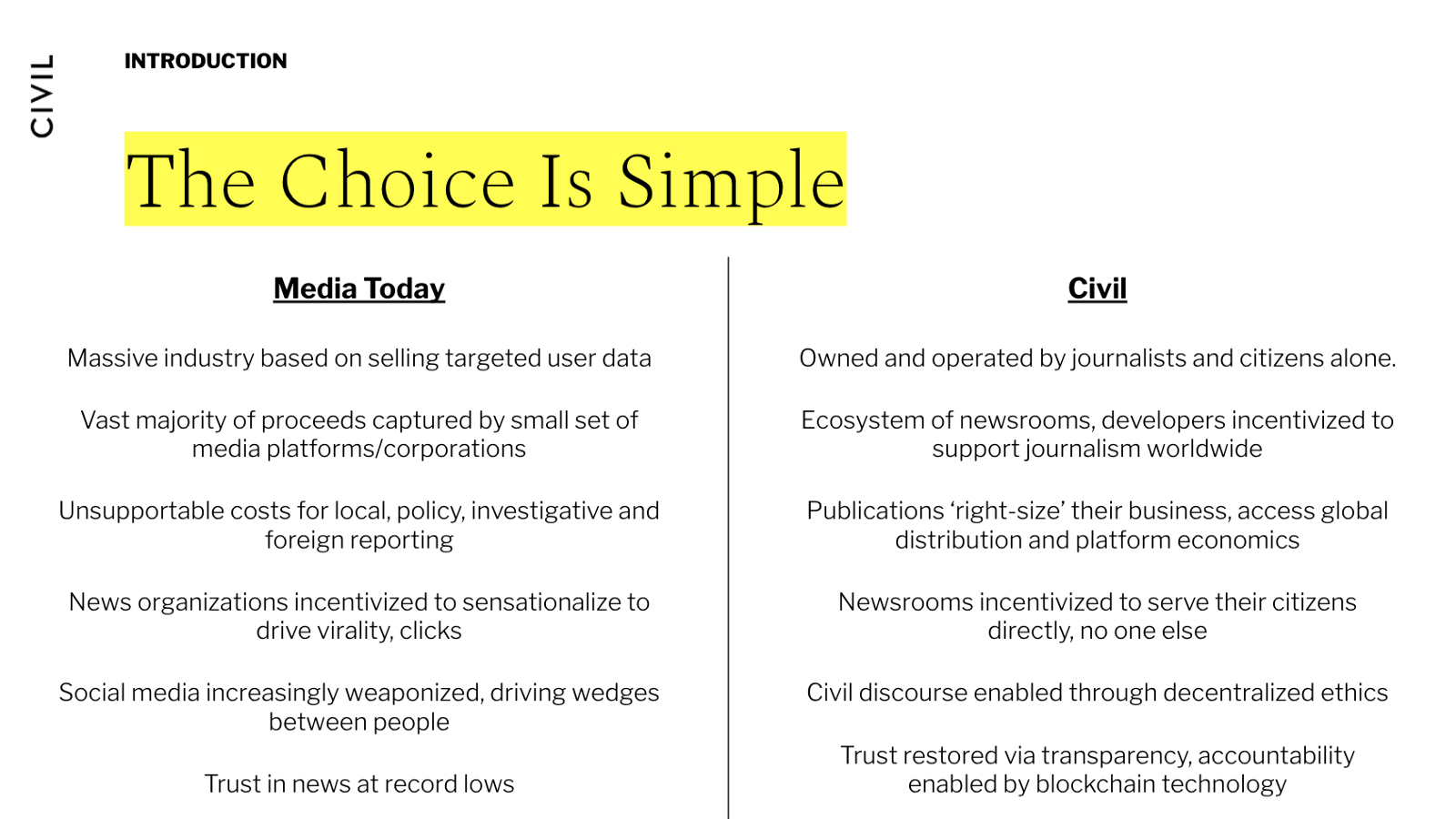
We believe that by cleaving digital media in two — Civil, and everything else — that we will open a massive array of marketplace businesses to monetize a platform predicated on maximum access, accurate information and civil discourse.
The Civil Media Company is not taking a cut of revenue flowing from citizens to newsmakers. While our CVL token reserve may effectively fuel the company for an extended period of time, it cannot be relied upon alone for Civil’s long-term growth and sustainability. The Civil Media Company will need to find ways to effectively monetize the Civil protocol without conflicting with our core mission.
In this spirit, The Civil Media Company may pursue two primary methods: direct and indirect monetization.
The Civil Media Company is “directly monetizing” the Civil platform whenever it charges users directly for its products, apps or services.
By contrast, The Civil Media Company is “indirectly monetizing” the Civil protocol whenever it invests in third-party products, apps or services that in turn charge users directly, thus allowing The Civil Media Company to participate in these organization’s financial upside akin to a VC.
DIRECT MONETIZATION
Following a series of brainstorming sessions internally as well as with our First Fleet newsmakers, we identified three core groupings of products, apps and services that The Civil Media Company could build to grow the Civil ecosystem in service of our mission, newsmakers and citizens.
Publishing
- CMS
- Reader
- Multimedia
- Citations
- Annotations
- Tagging
- Discovery
- Storage
Discourse
- Pseudonymity
- Self-ID
- Messaging
- Chat/Forum
- Crowdsourcing
- Reputation/Reviews
- Quora-style Q&A
- Polling
- Privacy
Pro Services
- Sales & Donations
- Freelancer Marketplace / Job Boards
- Fact-Checking / Research
- Training & Coursework
- Pre-Pub / Post-Pub Legal Review
- Licensing & Syndication
- Analytics & Modelling
- CRM
- Media Liability Insurance
- Security
The Civil Media Company may monetize some of these products, apps and services directly, but only where it does not come into conflict with our core mission: supporting quality, sustainable journalism throughout the world.
INDIRECT MONETIZATION
The Civil Media Company intends to establish two for-profit entities, Civil Studios and Civil Labs, to direct its third-party investments.
Civil Studios will be an independent for-profit entity motivated to pilot and fund marquee works of journalism (“Civil Originals” a la “Netflix Originals”). Civil Studios will seek white spaces with big upside (e.g. podcasts, documentaries, big names), acting as a producer investing for upside and providing high-level support but not directly involved in the legwork. If The Civil Media Company wins a Pulitzer, Emmy or Oscar, it’ll be because of an investment made by Civil Studios.
Civil Labs will be a for-profit entity motivated to develop commercially successful software apps, tools and widgets for the Civil ecosystem. Civil Labs will seek to stimulate our developer ecosystem and consumer/enterprise “app store” through mission-aligned investments with significant potential upside, working as half R&D lab (internal moonshots) and half accelerator (support other entrepreneurial ventures). Think: Y-Combinator for Civil.
We recognize that our own business model is big, ambitious and possibly crazy, but it’s also 100% aligned with our mission — the mission of journalism. Anything we do to monetize the Civil protocol that could also damage the value of the protocol would be more deleterious overall to our business..
//
This post has been a long time coming. We hope it adds useful context about our strategies on this front — and underscores our commitment to thinking big and challenging established norms. It’s a grand vision, and one that will still be met with skepticism by some. And yet, nothing new ever came from coloring inside the lines!
We will be making several key announcements about our launch in coming weeks. Soon more than 100 full-time newsmakers across 15 independent newsrooms will join us in introducing the world to a decentralized future for journalism. And this is just the tip of the iceberg.
We can’t wait for what’s to come — and we hope you’ll join us on this journey.